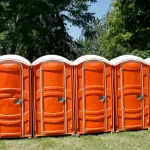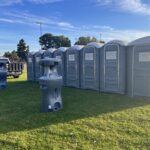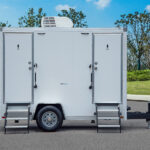
Every project manager running a construction site in the United States has to comply with OSHA’s portable sanitation rules. Most don’t realize the requirements are specific, enforceable, and citable — a missed restroom ratio can show up on an OSHA inspection just as fast as a missing hard hat. This guide walks through what OSHA actually requires, how to translate the rules into a sensible rental order, and what to ask your portable restroom provider before signing.
What OSHA actually requires
The rule lives at 29 CFR 1926.51(c) — “Sanitation” under the construction-industry standards. The toilet-facility table is short but binding:
- 20 or fewer workers: 1 toilet
- 20 to 199 workers: 1 toilet seat and 1 urinal per 40 workers
- 200 or more workers: 1 toilet seat and 1 urinal per 50 workers
These are minimums. They assume one continuous shift; multi-shift sites with overlap need additional units to keep wait times reasonable. The rule applies to every construction site where work continues for more than a single business day — meaning even short residential remodels and small commercial buildouts.
There’s also a separate OSHA requirement for hand washing: 29 CFR 1926.51(f) requires “adequate” washing facilities for any work involving skin contact with substances that need to be removed — concrete dust, paint, solvents, lead, asbestos abatement work, and more. Most contractors interpret this conservatively and add hand washing stations to any site with more than a handful of workers.
How to size your order in practice
The minimums are a starting point, but real-world sizing considers several factors:
Crew turnover. If your site has subcontractors flowing in and out during the day (HVAC, electrical, plumbing, framers all on overlapping schedules), peak headcount may be much higher than your daily-average headcount. Size for peak, not average.
Shift schedules. A 40-person crew working a single shift needs the OSHA minimum. The same 40 people split across two shifts with shift-change overlap can effectively double restroom demand during the transition. Add units accordingly.
Project duration. Short projects (1-4 weeks) can size tightly to OSHA minimums. Long projects (3+ months) benefit from one extra unit beyond the minimum to reduce wait-time complaints and turnover-related morale issues.
Climate. Hot-weather sites drive higher water consumption and higher restroom turnover. Cold-weather sites see lower turnover but place more strain on units (no break room for crews to use instead). Sites in the South should add 10-15% during summer; sites in the North should plan for service-truck access during snow.
Site geometry. OSHA requires toilets be “readily accessible” to all workers. On large sites — highway projects, big-box retail builds, sprawling solar installs — that means distributing units around the site, not clustering them at one trailer. Workers shouldn’t have to walk more than 200 feet (industry standard, stricter than OSHA’s text) to reach a unit.
Hand washing stations: when they’re required
If your project involves any of the following, plan for hand washing stations alongside porta potties:
- Concrete work (cement is a skin irritant — workers need to rinse)
- Painting, staining, or solvent use
- Lead paint removal or asbestos abatement (federally required)
- Demolition with dust exposure
- Welding (eye and skin contamination)
- Plumbing repair on existing systems (biohazard contact)
- Any food-service area on the jobsite (lunch trailers, mobile food trucks)
Standalone hand washing stations have fresh-water reservoirs, foot-pump operation, and soap dispensers — they’re independent of the porta potties and can be placed wherever workers congregate.
Servicing frequency
OSHA doesn’t specify how often units must be serviced, but the standard reads “maintained in a sanitary condition.” Industry-standard servicing schedules are:
- Small sites (1-2 units): weekly servicing
- Medium sites (3-10 units): weekly or twice-weekly servicing depending on use
- Large sites (10+ units): twice-weekly servicing minimum, often three times a week during peak crew weeks
- High-use sites (large festivals, mass crews, hot weather): daily servicing
A unit that hasn’t been serviced in a week with 40 workers using it will fail any inspector’s “sanitary condition” judgment call. Service rotations should be written into the rental contract, not assumed.
ADA-accessible units on public works projects
Public works projects (federal, state, or municipal) typically require ADA-accessible portable restrooms as part of the prevailing-wage / accessibility compliance for the site. The standard is one ADA unit per cluster of standard units. Private commercial and residential construction don’t have this federal requirement, but state and local rules vary — check your local permitting office.
Special situations
Long-distance or remote crews. Off-grid work sites (pipeline work, rural utility projects, wildfire mitigation crews) require self-contained units that don’t depend on local water access. Plan for trucked-in fresh water for hand washing stations.
Night shifts. Add interior LED lighting (battery-powered or solar) to any unit that’ll be used after dark. Most providers offer this as an add-on for a few dollars per unit per month.
Multiple trades on overlapping shifts. Track headcount by shift, not by total crew, when computing your unit ratio. A 60-person day shift overlapping with a 40-person night shift for two hours daily means your peak demand is briefly 100 workers.
Female workers on majority-male crews. Federal law doesn’t require gender-separated units, but many sites add a single female-designated unit when even one female worker is on a long-term crew. This is a morale and retention call more than a compliance call.
What to ask your portable restroom provider
Before you sign a construction-site rental contract, confirm in writing:
- OSHA-compliant sizing for your peak crew count — not your average. Get the math written into the quote.
- Service frequency — weekly minimum on any site with 20+ workers. Twice-weekly on sites with 40+ workers.
- Response time for emergency service calls — accidents, vandalism, weather damage. 24 hours is reasonable for non-urgent; 4-6 hours for hygiene emergencies.
- Replacement-unit policy — if a unit is damaged or unusable, how fast does a replacement arrive?
- Move-on-site pricing — if your project needs more units mid-project (the crew grew), what’s the add-on cost?
- Hand washing station availability — separate fresh-water units, not the basic in-unit hand sanitizer.
- ADA-accessible unit availability — required on public works, optional on private but increasingly expected.
- Removal and final cleanup — confirmed in writing as part of the base price, not an add-on at the end.
Patriot covers all of it
We handle construction site portable restroom rentals for projects of every size — from 5-person residential remodels to multi-hundred-worker commercial builds. We size to OSHA minimums (or your peak crew, whichever is larger), service on the schedule your project needs, and handle add-on units, hand washing stations, and ADA-accessible units from the same fleet. Long-term construction rentals get monthly billing, no surprise add-ons, and a dedicated account manager who knows your project.
For a related event-side guide, see our recent post on how to size porta potty rentals for events. Construction sizing is stricter (OSHA-bound) but the principles overlap.
Request a free quote with your project details — number of workers, project duration, location, and any special requirements (lead/asbestos, public works, night shift). We’ll come back with an OSHA-compliant unit count, a service schedule, and an all-in monthly price.
For more on portable sanitation logistics, see our FAQ page which covers pricing, equipment options, delivery, and service in depth.